
We have the right test adapter for your circuit boards
In electronics manufacturing, in-circuit testing (ICT) refers to the basic testing procedure for electronic assemblies or circuits (electrical circuits) and assembled circuit boards. These are placed in a special test adapter, which tests them for faults in the conductor tracks – such as short circuits or interruptions – soldering faults or component faults. CRS provides you with the appropriate test systems in various sizes and designs.
ICT can be used to measure both analogue parameters of components such as resistance, capacitance, inductance and much more using various measurement methods, as well as digital properties using specially defined test signals. Basically, the electrical networks are contacted by a test adapter. This is done using specially spring-loaded test probes or test needles with different head shapes. They strike the so-called test points on the circuit board using mechanical methods or compressed air. These are rectangular, square or round copper areas without solder resist, which are designed to prevent individual components of the circuit board or their solder joints from being damaged by contact with the test needles. Of course, care must also be taken to ensure that the force exerted by the needle bed adapter – i.e. test needles, contact points, hold-down devices, etc. – does not bend the test piece and thus damage it as a whole. Accordingly, the test adapter must have sufficient contact points to support the circuit board, but also sufficient hold-down devices to counteract the test needles.
Starting points for test adapter selection
Which test adapter is right for the respective application depends not only on the grid, but also on other factors. Depending on the test strategy and test depth, a pure functional test (FKT) is sometimes sufficient, for which only very few test points are usually required. In principle, functional and in-circuit tests, which enable troubleshooting at component level, can also be combined in a 2-stage adapter. And while a simple mechanical adapter is often sufficient for small series in the development phase, in-line adapters are necessary for large-scale series production, such as those offered by CRS in various designs on these pages. Let us advise you comprehensively on other steps in the overall PCB testing process – for example, equipping test adapters with efficient marking systems.
Solder frames
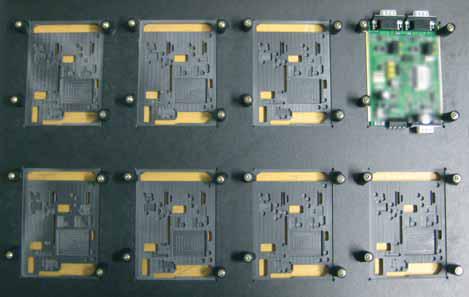
Using the CRS soldering frame you attain optimal
results in your soldering process.

______________________